A Nude Man Drawing
The Hirschsprung Collection has acquired a work by Jørgen Roed, which has recently undergone conservation.
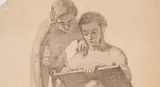
Jørgen Roed: Group of Models with a Seated Man Holding a Drawing Board and a Standing Boy, 1833. The Hirschsprung Collection.
“What are you doing? What is it supposed to be?” Artists throughout history have had to endure curious questions—and may occasionally have grown tired of persistent onlookers interrupting their work.
In this remarkable drawing by Jørgen Roed (1808–1888), however, the roles have been playfully reversed. The models in the studio have become artist and spectator. Or perhaps the artist himself has simply removed his clothes? In the world of art, perhaps everyone is equal—and equally human—once the clothing that signals social rank has been cast aside. At the same time, the relationship between the two men appears strikingly intimate, as though they may know one another. It is an unusual and intriguing scene.
The Grand Silver Medal
An inscription in ink at the lower left of the drawing reads: “Awarded the Grand Silver Medal, 21 March 1833.” The work was submitted as part of a competition at the Royal Danish Academy of Fine Arts in Copenhagen, where Roed had been studying for more than ten years. He had started young, enrolling at the age of 14, shortly after his confirmation. With this prize, Roed completed his training at the age of 25.
Surprisingly, the subject was not unique. Several artists were awarded silver medals for drawings of the same two models. But who devised this unusual arrangement and its playful narrative? Further research may provide the answer. Perhaps one of the Academy’s permanent teachers was responsible.
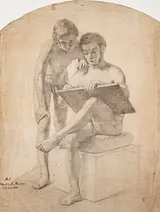
Jørgen Roed’s drawing before conservation.
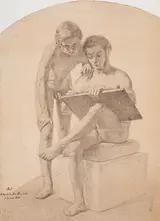
After conservation. Jørgen Roed’s drawing now appears at its best.
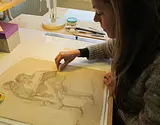
During the conservation of Roed’s drawing. Paper conservator Karen Esser, MSc, specialises in works of art on paper.
The Hirschsprung Collection acquired this masterful drawing in autumn 2020. Its exceptional handling of light and shadow is immediately apparent. Soon afterwards, it was sent to the National Gallery of Denmark for conservation, where paper conservator Karen Esser treated it with meticulous care.
The work included removing a considerable amount of surface dirt and repairing tears along the edges of the paper. A supporting structure was also added to the reverse. The paper’s appealing but irregular shape made it difficult to mount securely on card, so this concealed support was necessary.
When Jørgen Roed was a young student at the Royal Danish Academy of Fine Arts, the human body and its anatomy were perhaps the most important subjects in an artist’s training. Only a few years later, by the 1840s, landscapes had become the preferred subject among buyers.
Throughout the 19th century, however, people of modest means could earn a living for shorter or longer periods by working as models at the Academy. They had to remain still and be sufficiently interesting to draw. Nude modelling, moreover, paid twice the usual rate.
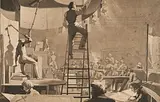
Throughout the 19th century, students at the Royal Danish Academy of Fine Arts learned to draw from live models. Wilhelm Bendz studied at the Academy alongside Jørgen Roed and depicted a life-drawing class in 1826.
Wilhelm Bendz: The Life Class at the Academy, c. 1826. The Hirschsprung Collection.
Working as a nude model required an attractive physique and was not considered a respectable profession. In 1822, one male model even complained that he had been mocked because of his work.
Today, we do not know the identities of the models drawn by Roed and his fellow students. Like so many people from the period who held no social position or status, their voices have long since been lost.
The drawing remains—beautifully restored and almost new in appearance—as a record of a very different kind of art and artistic training from that of today. At the same time, it preserves the memory of two Danish men who would otherwise have been forgotten.
The work is also a visual joke that can still make us smile: who is looking at whom, and who is the artist and who is the subject? Great works of art can bring together many different threads and prompt us to reflect on a wide range of questions. Jørgen Roed’s large drawing does just that, connecting us, for a moment, with the past and the people who lived in it.