A Sensuous Landscape by P.S. Krøyer
With support from the Aage and Johanne Louis-Hansen Foundation and the Danish Agency for Culture and Palaces, the museum was able to acquire an important work by P.S. Krøyer in autumn 2019, painted during his stay at the spa town of Luchon in 1886. The museum holds one of Denmark’s largest collections of works by P.S. Krøyer, and this acquisition adds a new dimension to the representation of the widely travelled artist in the collection.
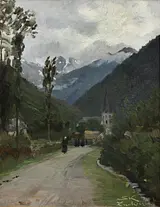
P.S. Krøyer: Mountain Landscape in Grey Weather with Figures on a Road. Luchon, 1886. The Hirschsprung Collection.
The newly acquired painting was created in Luchon in southern France, close to the Spanish border, where Krøyer was staying for health treatments during the summer of 1886. He spent his first few days in a hotel before moving into a private house with a garden by the river, where he could enjoy some solitude. In a letter dated 15 June 1886, he wrote enthusiastically about his stay:
I have already been here for more than eight days, and it really is absolutely delightful. Under these circumstances, taking the cure is easy—it is a genuine pleasure to be a patient here. […] As I have said, the place is enchanting. There are wonderful walks through the valleys at all times of day, always with views of the high, imposing snow-capped peaks. Unfortunately, the weather has been very poor so far, with rain almost every day.
The painting depicts one of the overcast days Krøyer describes in his letter, with low clouds hanging over the Pyrenees. He has positioned himself on a road through the valleys, looking towards the high, snow-covered peaks. Lush vegetation frames the road, while a few scattered figures provide natural points of focus and lead the viewer’s eye towards the grey church in the distance.
The crowns of the trees are suggested with just a few light brushstrokes, and the plants have been rapidly sketched onto the canvas. This swift handling gives the scene a spontaneous quality while also conveying the sense of thick, humid air. During his stay, Krøyer made numerous excursions into the countryside around Luchon. In the same letter from 1886, he describes a daily routine that also involved plenty of mineral water and frequent baths:
The crowns of the trees are suggested with just a few light brushstrokes, and the plants have been rapidly sketched onto the canvas. This swift handling gives the scene a spontaneous quality while also conveying the sense of thick, humid air. During his stay, Krøyer made numerous excursions into the countryside around Luchon. In the same letter from 1886, he describes a daily routine that also involved plenty of mineral water and frequent baths:
I get up at seven in the morning and go straight to the baths, where I drink mineral water and bathe. Then I return home, have my morning coffee and rest for a while. Afterwards, I go for a ride or a walk until noon, when I have lunch. I usually paint for a while, or find something else to do, and at four or five I take the waters and bathe again. I have dinner at seven and go to bed at ten. There you have my day.
On one of his daily walks, Krøyer evidently found his way to a local tavern. The museum already owns Workers in a Tavern in Luchon, painted during the same period. The scene of three workers quietly spending time together was created in the nearby town of Saint-Mamet.
It is considerably darker than the newly acquired landscape and recalls some of Krøyer’s earlier depictions of rugged fishermen in Skagen. In particular, it brings to mind his first painting from the northern Jutland town, In the Merchant’s Shop When There Is No Fishing from 1882, which is also part of the museum’s collection.

P.S. Krøyer: Workers in a Tavern in Luchon, 1886. The Hirschsprung Collection.
.jpg)
P.S. Krøyer: In the Merchant’s Shop When There Is No Fishing, 1882. The Hirschsprung Collection.