An Atmospheric Work by Bertha Wegmann
The Hirschsprung Collection has recently acquired Bertha Wegmann’s (1846–1926) evocative painting Blue Fan Beside a Green Jug with a Blossoming Apple Branch. Previously held in a private collection, the work can now be seen at the museum thanks to generous support from the New Carlsberg Foundation.
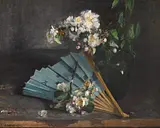
In Blue Fan Beside a Green Jug with a Blossoming Apple Branch, which measures approximately 55 × 69 cm, a luminous, almost turquoise-blue fan is placed beside flowering apple branches in a vase. In the foreground, a single heavy branch has broken off, scattering a few bright leaves across the table. The arrangement is set against a dark background, allowing the painting’s subtle effects of light and shadow to come to the fore.
The Hirschsprung Collection already holds a substantial body of work by Bertha Wegmann, including portraits, landscapes and urban scenes. The first of these, Portrait of Petrea Hirschsprung (1888), was acquired by the museum’s founder, Heinrich Hirschsprung, as early as 1890.
This new acquisition is the first still life by Wegmann to enter the museum’s collection. It therefore adds a new dimension to the way her work is represented at the museum, while also standing in its own right as an exceptional work within her oeuvre.
A Leading Figure in 19th-Century Danish Art
During her lifetime, Wegmann was best known as a highly accomplished and sought-after portrait painter. Following P.S. Krøyer’s death in 1909, she was unrivalled in the field. Portraiture, however, was far from the only genre she explored. Her work also includes outstanding landscapes, urban scenes and still lifes. The newly acquired Blue Fan Beside a Green Jug with a Blossoming Apple Branch is one such example, revealing the influence of both Japanese art and the French art scene of the 1870s.
Bertha Wegmann was one of the most highly regarded artists of her generation. As a leading portrait painter within Danish Realism, she was also one of the few women artists of her time to achieve widespread recognition and respect for her work.
The Hirschsprung Collection is delighted to have added this evocative painting to the museum’s collection. It is now on display in Gallery 17.