Augusta Dohlmann and Sofie Holten
The museum has recently acquired two paintings by Augusta Dohlmann and one by Sofie Holten. These are the first works by either artist to enter the collection.
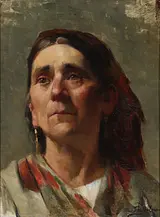
In 1891, Augusta Dohlmann painted this striking portrait of an Italian woman wearing a red headscarf and earrings. Her face is half in shadow and half illuminated. With her lips firmly closed and brow furrowed, she turns her gaze to the left.
From her debut in 1880 onwards, Augusta Dohlmann exhibited regularly at Charlottenborg and took part in several major international exhibitions. Her work was shown at the Paris Salon on several occasions, as well as at the 1889 Exposition Universelle in Paris and the 1893 World’s Columbian Exposition in Chicago. She was also represented by Durand-Ruel, the renowned Paris art dealer associated with the Impressionists, who sold her paintings on commission.
Dohlmann played an active role in establishing the Academy of Fine Arts’ School of Art for Women, which opened in 1888. She was also a member of the committee behind the landmark Women’s Exhibition of 1895, and in 1897 she became the first woman to join the board of the Artists’ Association of 18 November. Throughout her career, she worked to improve conditions for younger women artists and established, among other initiatives, a grant for women flower painters.
Dohlmann travelled extensively abroad. In the early 1890s, she spent several years in Italy, where she painted An Italian Woman with a Red Headscarf and Earrings, recently acquired by the museum. Having studied in Paris on several occasions, Dohlmann was strongly influenced by French Realism. This is clearly evident in the painting’s muted palette and bold, vigorous brushwork.
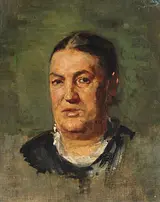
With broad, vigorous brushstrokes, Sofie Holten has captured Madam Ullebølle’s distinctive features. Her mouth is slightly open and her eyes narrowed as she looks directly at us.
Sofie Holten – A Portrait of the Striking Madam Ullebølle
With the acquisition of the undated Portrait of Madam Ullebølle, Sofie Holten (1858–1930) is now also represented in the museum’s collection.
Madam Ullebølle is best known as the painter Kristian Zahrtmann’s most important model. She posed for several of his history paintings depicting unconventional women, including a number of his celebrated works featuring the royal daughter Leonora Christina. She also appears in several paintings by Zahrtmann in the museum’s collection.
Through Zahrtmann’s many portrayals of her, Ullebølle became a familiar figure in Danish artistic circles and was painted by several other prominent artists of the period, including J.F. Willumsen and Peter Ilsted. Sofie Holten was evidently fascinated by this striking model, whose large physique and somewhat coarse features stood in contrast to conventional ideals of female beauty around 1900.
An Advocate for Women’s Rights
Sofie Holten studied under Christen Dalsgaard and Carl Thomsen before travelling to Paris at the age of 21 to continue her artistic training. In France, she embraced the latest developments in painting and subsequently spent extended periods abroad.
Holten was known in her own time for her commitment to the women’s movement and for exhibiting widely in Denmark and internationally. She exhibited regularly at Charlottenborg and took part in the Women’s Exhibition of 1895, which she had helped organise alongside Augusta Dohlmann. Her work was also shown at the Paris Salon in 1886 and at the World’s Columbian Exposition in Chicago in 1893.
Sofie Holten was a close friend of The Hirschsprung Collection’s first director, Emil Hannover (1864–1923). He described her as “one of the most modern colourists of her time, who consumed cold blue-green colours in enormous quantities”.
Several exchanges of letters between the two friends are preserved in the museum’s extensive archives. These letters, which provide insight into some of the issues that occupied Sofie Holten during the final decades of the 19th century, have been digitised.