Bertha Wegmann’s Women in the Forest
The Hirschsprung Collection has acquired a new work by Bertha Wegmann (1847–1926). Since the museum’s major exhibition devoted to the artist in 2022, we have worked to strengthen the representation of her art in the museum’s collection. Wegmann is now one of the artists who attracts the greatest interest among our visitors, while the acquisition of her extensive archive has opened up new opportunities for research into her life and work.
In Woman Seen from Behind, a woman stands before a view that remains hidden from us. Her face cannot be seen, and her hands are clasped thoughtfully behind her back. This gives the painting an intriguing and enigmatic atmosphere. Perhaps she has simply paused during a walk in the woods. Or perhaps she is reflecting on the life she has lived and the path ahead.
Although the woman is standing still, the painting is full of movement. Wegmann applied the paint in a lively and visible manner, particularly in the forest and landscape surrounding the figure. The work adds a new dimension to the museum’s collection of Wegmann’s art and reflects her interest in nature, identity and the inner life of the individual – themes that continue to resonate today.
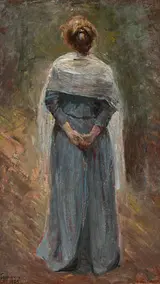
Bertha Wegmann: Woman Seen from Behind, 1909. The Hirschsprung Collection.
Woman Seen from Behind was painted in 1909 and belongs to the later part of Wegmann’s career. The motif of a woman viewed from behind appears in several of her works. Wegmann’s archive includes a number of intense drawings of women in dark spruce and pine forests. Several of the figures have their backs turned to us and seem almost to merge with the trees and the surrounding darkness. The relationship between women and nature was evidently a subject of both personal and artistic significance to Wegmann.
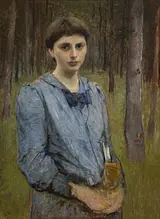
Bertha Wegmann: A Young Girl in the Forest (Toni Möller), 1895. The Hirschsprung Collection
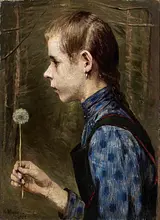
Bertha Wegmann: Marthel with a Dandelion Clock. Wölfelsgrund, 1909. The Hirschsprung Collection.