Study and Masterpiece Reunited
With support from the Augustinus Foundation, the museum has acquired Danish Golden Age painter Fritz Petzholdt’s From the Pontine Marshes, painted around 1836. The work is a study for one of the artist’s major paintings, which has been part of the museum’s collection for more than a century.
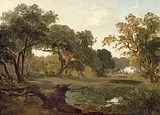
In Fritz Petzholdt’s small oil study From the Pontine Marshes, painted around 1836 and now part of the museum’s collection, the eye is drawn past the trees’ twisting trunks and green canopies towards the blue mountains in the distance.
Danish Golden Age art is one of the cornerstones of The Hirschsprung Collection, particularly the tradition associated with the painter and Academy professor C.W. Eckersberg. Among the artists whom the museum’s founders, Pauline and Heinrich Hirschsprung, held in especially high regard was Fritz Petzholdt (1805–1838), one of Eckersberg’s pupils.
Petzholdt was a privileged artist. Having inherited a substantial fortune, he enjoyed both financial and artistic freedom. Unlike many other artists of his generation, he did not have to rely on portrait commissions to make a living. Instead, he was free to devote himself to landscape painting, a genre that had not yet fully established itself in Denmark. His financial independence allowed him to focus entirely on the landscape, often during the extensive travels that came to play such an important role in his art.
A Study for a Masterpiece
The painting acquired by the museum at a Bruun Rasmussen auction in June 2020 is a preparatory study for Petzholdt’s undisputed masterpiece: the large and meticulously finished View of the Pontine Marshes with a Herd of Buffaloes, completed in his Munich studio in 1836.
Petzholdt travelled to Italy in 1830 and remained there for the next six years. When the summer heat in Rome became oppressive, the mountains and countryside surrounding the city were popular destinations for artists. The remote Pontine Marshes also attracted the young painter, although visiting the area was not without danger: malaria was widespread, and travellers risked encountering bandits. The only inhabitants were herdsmen tending the cattle grazing in the marshes. Perhaps it was precisely this wild, sparsely populated landscape that appealed to Petzholdt and persuaded him to venture into the region with his painting box.
The study provides insight into how the final composition developed. It does not yet include the buffaloes resting beside the river in the finished painting, and Petzholdt was still experimenting with the shapes of the trees, which appear differently in the final version. The basic composition, however, was already in place—not least the view towards the blue mountains on the horizon.
The study provides insight into how the final composition developed. It does not yet include the buffaloes resting beside the river in the finished painting, and Petzholdt was still experimenting with the shapes of the trees, which appear differently in the final version. The basic composition, however, was already in place—not least the view towards the blue mountains on the horizon.
In contrast to the detailed and precise execution of the finished work, the study is painted with freer, more fluid brushstrokes. Working swiftly and confidently, Petzholdt sketched the trees in the foreground, using them to frame the atmospheric landscape beyond.
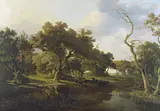
The museum’s founders, Heinrich and Pauline Hirschsprung, acquired Petzholdt’s masterpiece View of the Pontine Marshes with a Herd of Buffaloes in 1901. In the painting, the twisted trees and resting buffaloes are reflected in the still, dark water.
A Travelling Artist
Petzholdt’s years of travel, which took him to Dresden, Prague, Munich, Sicily, Capri and Naples, left a clear mark on his art. During his time in Italy, he became associated with the German artists’ colony based at Casa Baldi in Olevano, a small hill town outside Rome. After leaving Italy, he moved to Munich.
Critics in Denmark took particular note of the German influence in his work. The golden tones and Romantic landscapes in his paintings were even described as ‘un-Danish’. In this sense, Petzholdt became one of the first so-called ‘Europeans’ in Danish art history—a term that was not intended as a compliment in Denmark at the time.
Petzholdt’s life also came to an abrupt end far from his native country. He died at the age of 33 while staying in Greece.