The Many Facets of Bertha Wegmann
Three new works reveal the remarkable breadth of Bertha Wegmann’s art.
Bertha Wegmann: Resignation, 1890. The Hirschsprung Collection
The museum has acquired three works by Bertha Wegmann: Resignation, 1890, acquired with support from the New Carlsberg Foundation and the Danish Agency for Culture and Palaces; A Young Woman in the Forest (Toni Möller), undated, acquired with support from the New Carlsberg Foundation; and Still Life with Nettles in a Glass Vase, undated, acquired with support from the Augustinus Foundation.
The three works are important additions to the museum’s existing collection of Wegmann’s art. Two of them were included in the 2022 exhibition Painting in Many Languages, and both are closely connected to the artist’s own life.
Loneliness and despondency
One of the paintings shows Wegmann as a despondent young woman, lost in thought while reading. Its title evokes the French literature of the period, while the subject explores the loneliness and discouragement that modern life could bring—particularly for women who stepped outside the security of family life by choosing a professional career over the expected roles of wife and mother.
A Symbolist atmosphere
The painting of a young woman in the forest is also a portrait of one of Wegmann’s closest companions, Toni Möller, who was 17 years her junior and served as the artist’s muse, model and secretary.
The young woman’s luminous face conveys Wegmann’s fascination with Toni. She is also portrayed with distinctly modern features: a short, boyish haircut and a dress whose loose cut recalls the new reform dress. The sailor collar may perhaps also suggest a non-binary gender identity. This is one of the few works in which Wegmann creates a distinctly Symbolist atmosphere. The forest surrounding the young woman seems intended less as an accurate study of nature than as a means of evoking a particular mood.
Bertha Wegamann: A Young Woman in the Forest (Toni Möller), undated. The Hirschsprung Collection
The More Subversive Side of Womanhood
The small, understated bouquet of nettles in the recently acquired still life is a highly unusual subject within the floral repertoire of the period. It also offers a telling comment on the modern age in which Wegmann lived and worked.
The bouquet presents a new perspective on flower painting, a genre closely associated with women in the 19th century and considered suitably feminine because it kept them from addressing subjects deemed inappropriate. By depicting not only a weed, but one capable of stinging, Wegmann suggests more unruly and potentially disruptive aspects of women’s character and creative work than those traditionally associated with the beautiful, fragrant and delicate flowers commonly used as symbols of femininity.
The paintings can be seen in the museum’s new special display of works by Bertha Wegmann in Gallery 15.
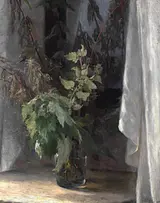
Bertha Wegmann: Still Life with Nettles in a Glass Vase, undated. The Hirschsprung Collection.