Twilight by Johan Rohde
In the summer of 2020, The Hirschsprung Collection acquired Johan Rohde’s Evening by the River Karup from Bruun Rasmussen Auctioneers. The painting dates from 1889.
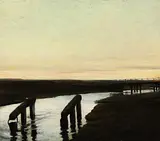
Johan Rohde: Evening by the River Karup, 1889. The Hirschsprung Collection. The river winds through the landscape like a ribbon of silver.
The museum already holds a substantial collection of works by Johan Rohde, while its archives contain both the artist’s sketchbooks and an extensive collection of his letters. The newly acquired painting is dated 1889, when Johan Rohde (1856–1935) was staying in Jutland and produced a series of works depicting the area around the River Karup.
At auction, the painting was titled Evening Mood by a River. Subsequent research has shown, however, that it was exhibited at Den Frie Exhibition in 1892 under the title Evening by the River Karup, as catalogue no. 64.
Rohde captures the distinctive atmosphere of a light Nordic summer night. The river curves gently to the right, while a bridge stands out in dark, decorative contrast against a sky illuminated by the final golden rays of the evening sun. Winding through the silent landscape like a ribbon of silver, the river reflects the colours of the sky. The shadowy contours of the surrounding countryside make the water appear as a luminous ornament beneath the vast, glowing summer sky, emphasised by the painting’s low horizon.
The work is an early example of the new atmospheric art of Symbolism, which would come to prominence during the 1890s. This development coincided with the establishment of the artist-run exhibition venue Den Frie Exhibition, which Rohde helped found alongside artists including J.F. Willumsen and Vilhelm Hammershøi.
The museum already holds several works from these early years of Rohde’s career. In paintings such as Grey Weather. Ribe, 1890, and Late Evening by the Harbour Pier in Hoorn, 1893, he continued to explore these quiet, atmospheric landscapes.
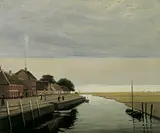
Johan Rohde painted the atmospheric Grey Weather. Ribe in 1890. The town of Ribe can be seen on one side of the river, while flat fields stretch as far as the eye can see on the other. The work belongs to The Hirschsprung Collection.
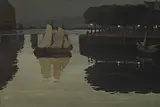
Johan Rohde was fascinated by the reflections on the water and the quiet atmosphere he encountered in the Dutch port town of Hoorn. It was here that he painted his now-famous Late Evening by the Harbour Pier in Hoorn in 1893. The Hirschsprung Collection.
A Reformer of Danish Art
Johan Rohde was one of the leading figures of Danish Symbolism. Throughout his life, he was engaged not only in his own artistic practice—which encompassed painting, furniture design and silverwork—but also in the major changes that transformed the Danish art world during the 1880s and 1890s.
When the artist-run Artists’ Independent Study Schools opened in 1882, the protest against the established Royal Danish Academy of Fine Arts was largely orchestrated by Rohde. A decade later, he was once again at the centre of artists’ dissatisfaction, this time with the exhibitions at Charlottenborg. The movement culminated in the establishment of Den Frie Exhibition in 1891.
Rohde was also a widely travelled artist who understood the importance of engaging with new artistic developments beyond Denmark and bringing fresh impulses into Danish art. This is documented in his extensive correspondence with Emil Hannover, the museum’s first director. Their close friendship and the letters preserved in the museum’s archives are explored further in an article available here.