People on the Beach
P.S. Krøyer’s A Little Barefoot Fisher Girl from 1874 is a new long-term loan to The Hirschsprung Collection.
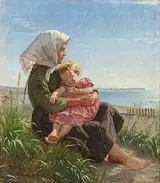
P.S. Krøyer: A Little Barefoot Fisher Girl, 1874.
There she sits, the young fisher girl with her little sister on her lap. Perhaps they are waiting for their parents. She squints slightly as she looks out towards the sea in the bright sunlight. Is the older child patient, or simply tired? Either way, she already carries a great deal of responsibility.
The work by P.S. Krøyer (1851–1909) is on loan to The Hirschsprung Collection and is currently on display in one of the museum’s galleries. We are grateful to the private owner for allowing the painting to be enjoyed by the public for the next few years.
The Exotic Appeal of North Zealand
Between 1873 and 1876, P.S. Krøyer spent his summers in the fishing village of Hornbæk. He was regarded as a promising young artist, and it was during these years that he sold his first major paintings. They depicted local people from the coast, either at work or at rest.
The small town in North Zealand provided Krøyer with exactly the subjects he was looking for. To wealthy city dwellers, these scenes would have appeared both exotic and authentic. Hornbæk was far removed from life in the capital and had not yet become a fashionable resort.
Although Krøyer was only in his early twenties, he was already earning money from portrait commissions. Selling paintings that had not been commissioned in advance, however, was a more ambitious undertaking. Several young artists were drawn to Hornbæk for the same reason, hoping to find unusual and compelling subjects there. Krøyer proved the most successful. He would later continue painting fishermen in Skagen, about as far from the streets of Copenhagen as it was possible to go in Denmark.
Krøyer Before Krøyer
The young P.S. Krøyer had already completed his studies at the Royal Danish Academy of Fine Arts in Copenhagen by 1870. He had enrolled in 1864 at the age of 13, so his artistic training had been a long one. Now he had to establish himself as an independent artist.
Krøyer approached painting with extraordinary care, just as the Academy’s older professors had taught him. A new work would first be planned through drawings on paper and small oil studies. He would then carefully sketch the final composition in pencil on the canvas before building up the image in thin layers of paint.
In 1876, Krøyer travelled to Paris and transformed his style. It was after this that he achieved widespread fame. The new Krøyer, now a cosmopolitan artist, painted very differently from the one who had come before. Inspired by French art, he began to apply the paint more generously and fluidly, using quicker, freer brushstrokes.
The Human Touch
Before his time in France, Krøyer painted the fishermen of Hornbæk in a meticulous style, as can also be seen in this painting of the young girl and her sister on the beach.
One quality unites these early Hornbæk paintings with the later works for which Krøyer is known from France and Skagen: his ability to portray people in a way that makes us feel both affection for them and an understanding of who they are.
A Little Barefoot Fisher Girl captures a passing moment and is filled with small, telling details: the older girl’s squinting, childishly serious face, her little sister’s rosy cheeks and the different ways in which their hands grasp and hold. Notice, too, the striking contrasts between the colours. The sunlight is dazzlingly bright.
At the same time, the painting has a tenderness that draws us into the lives of the two young figures on the beach. Krøyer’s painting contrasts sharply with another image of a fishing community from the same year, 1874, which the museum has recently acquired: Carl Bloch’s A Young Sailor. The young man is full of attitude—self-assured and anything but vulnerable.
A comparison of the two works also reveals the period’s different expectations of men and women and the responsibilities—or lack of them—placed upon each: more duties for women, greater freedom for men.
The Hirschsprung Collection and Krøyer
The museum began as a private collection and today holds an extensive body of work by P.S. Krøyer, including paintings, sculptures and drawings, as well as long and highly personal letters, some of them illustrated.
The museum’s founders, Pauline and Heinrich Hirschsprung, acquired many works by Krøyer, among them two major paintings from Hornbæk: From the Smithy in Hornbæk, 1875, and Morning at Hornbæk. The Fishermen Coming Ashore, 1875. Equally important was the support they offered the young artist through travel grants, encouragement and gifts.
Today, The Hirschsprung Collection and P.S. Krøyer are inextricably linked. This makes us all the more delighted to have A Little Barefoot Fisher Girl on loan to the museum.