Two new Works by Bertha Wegmann
The museum has acquired a major portrait by Bertha Wegmann depicting the young Marie Triepcke. The painting set a new Danish auction record for a work by a woman artist.
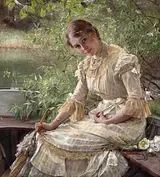
The portrait of Marie Triepcke (later Krøyer) clearly reflects Wegmann’s continued engagement with the subjects of Naturalism and the coloured shadows of Impressionism, both of which she had encountered in Paris.
Bertha Wegmann
Bertha Wegmann was one of the leading artists among the new generation of women painters who entered the art world in the final decades of the 19th century. In this work, she portrayed her pupil and fellow artist, the young Marie Triepcke (1867–1940), who would later become known as Marie Krøyer.
Despite playing a vital role in the Modern Breakthrough, Bertha Wegmann (1847–1926) was one of several women artists who were largely written out of 20th-century art history. This is particularly striking in Wegmann’s case, as she was an internationally acclaimed artist who received numerous honours both in Denmark and abroad. She took part in the major international exhibitions of her time and was a highly sought-after portrait painter among the highest echelons of Danish society.
The Hirschsprung Collection is working strategically to strengthen the representation of 19th-century women artists in the museum’s collection. This major acquisition is a result of that work. It is not only a masterpiece within Wegmann’s body of work, but also an important addition to the museum’s collection as a whole.
With a hammer price of more than DKK 3 million, it is also the most expensive work by a woman artist ever sold at auction in Denmark. The museum sees this as a sign of the rapidly growing interest in the women painters of the period.
The Paris Salon of 1885
Born in Switzerland but raised in Denmark, Wegmann was one of the few women artists of her generation fortunate enough to have a father with a keen interest in art. With his encouragement and financial support from the patron Moritz Gerson Melchior, she was able to pursue an artistic education.
She studied in Munich, as women were barred from attending the Royal Danish Academy of Fine Arts. From the age of 20, Wegmann spent 15 years abroad, the final years in Paris, where she achieved her breakthrough at the Paris Salon in 1881. The following year, she exhibited there again and received further recognition. The portrait of Marie Triepcke was in all likelihood the work by Wegmann accepted for the Paris Salon of 1885.
By then, the successful artist had returned to Denmark and had been awarded the Thorvaldsen Exhibition Medal.
The Portrait of Marie Triepcke
The portrait of Marie Triepcke clearly reflects Wegmann’s continued engagement with the subject matter of Naturalism and the coloured shadows of Impressionism, both of which she had encountered in Paris. Marie is seated in a boat, apparently on what is now the lake in Tivoli Gardens. The lush vegetation of the former moat surrounds her, while large white peonies lie on the bench beside her.
Wegmann’s exceptional technical skill is evident in the handling of the dress: the sheen of the fabric, its stripes and the delicate lace edging the neckline and sleeves are painted with a virtuosity rarely seen in Danish art of the period—with the possible exception of P.S. Krøyer, whom Marie Triepcke would later marry.
A very different dynamic
The comparison ends there, however. Wegmann’s portrait offers a striking contrast to the image of Marie Krøyer that is familiar today, shaped largely by the paintings of her famous husband. In his work, she became known as his most beautiful model, often portrayed turned away from the viewer in a closed pose, her gaze distant and full of longing.
Wegmann presents the 18-year-old fellow artist with an entirely different sense of dynamism, energy and intensity. Marie looks directly at us. Leaning forward slightly, with one arm bent towards her body, she creates an intimate space between sitter and painter - a space that reminds us that every portrait is shaped by the relationship between the two.
Here, that relationship was between two painters whose careers would develop very differently within the limited opportunities available to women artists at the time. Marie Triepcke’s career was constrained during her marriage to P.S. Krøyer. Bertha Wegmann, who never married, became one of the period’s most highly regarded women artists and was virtually unrivalled as a portrait painter following Krøyer’s death in 1909.
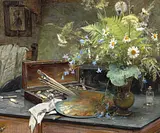
Bertha Wegmann: Still Life with a Bouquet of Wildflowers and the Artist’s Palette, c. 1882. The Hirschsprung Collection.
Still Life with Wildflowers
At the same auction, the museum acquired an exceptional still life with wildflowers, probably painted during Wegmann’s highly productive period in the 1880s. The palette, paint box, brushes, tubes of paint and half-smoked cigar left at the very edge of the table all suggest the artist’s presence, allowing the work to be seen as a form of artistic self-portrait. The painting complements the museum’s remarkable acquisition earlier this year of a still life with a fan, which reflects other aspects of Wegmann’s artistic inspiration from Paris.
With these two new acquisitions, The Hirschsprung Collection now holds 11 works by Bertha Wegmann—the largest collection of her art in Denmark. Together, the works reveal the many different painterly styles she explored, partly as a result of the artistic schools and traditions she encountered during her many years abroad in various parts of Europe, but perhaps also as a deliberate artistic strategy.
The works were acquired with support from the Aage and Johanne Louis-Hansen Foundation, the Augustinus Foundation and the New Carlsberg Foundation.
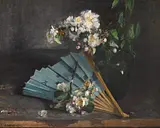
Bertha Wegmann: Blue Fan Beside a Green Jug with a Blossoming Apple Branch. Undated. The Hirschsprung Collection.